Family Bike Hire: Kidseats, Tag-Alongs and Trailers Explained
7 November 2026 · Four Swags
- Kidseats, tag-alongs and trailers: what each is best for
- Matching bike gear to your child's age and the trail
- Hiring family bike gear from locals on Four Swags
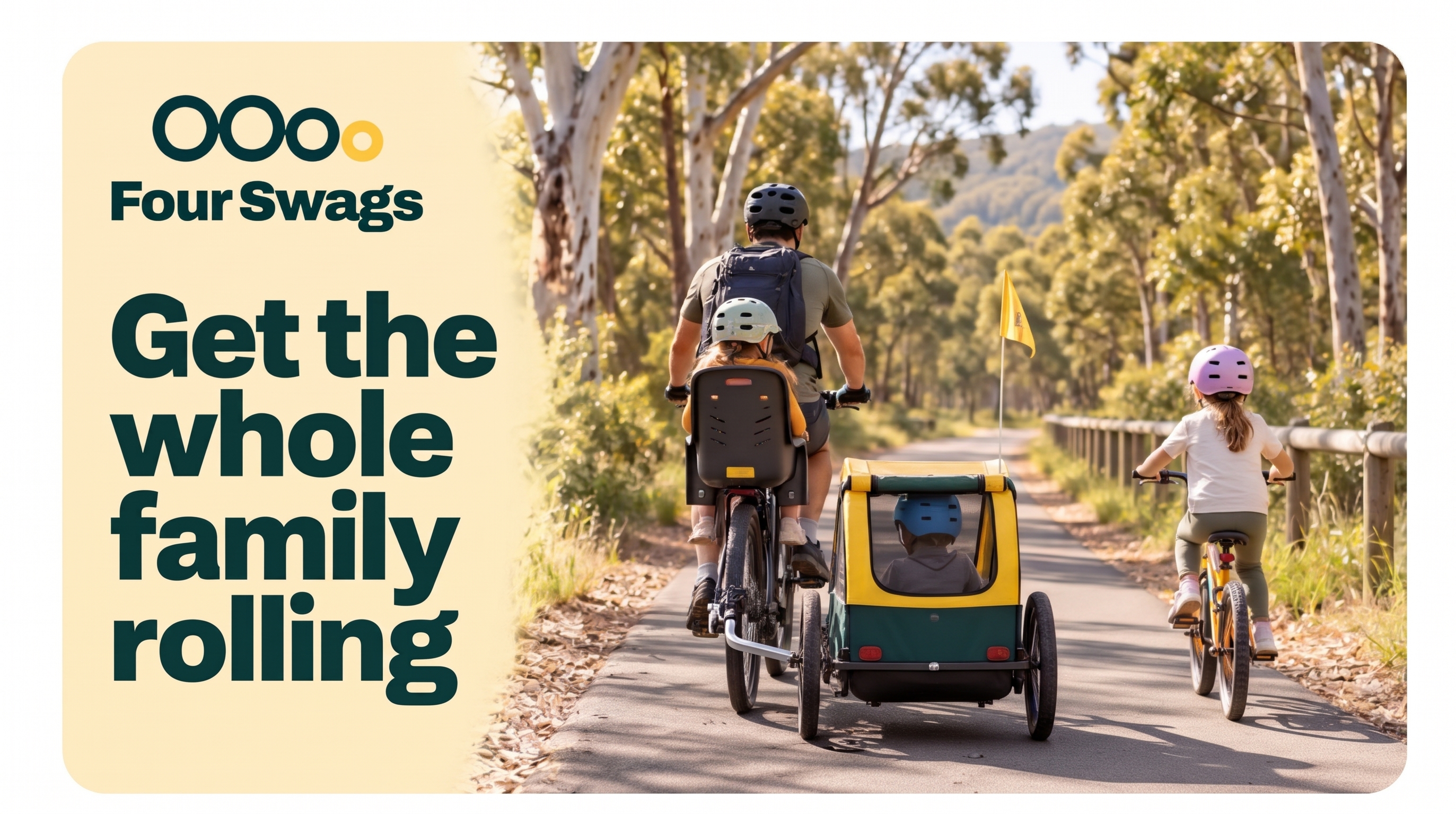
A family bike ride sounds simple until you remember that one of you has a set of legs roughly 40 centimetres long. Suddenly you're not planning a ride, you're solving a logistics puzzle.
The good news: the solution is well sorted, and you don't have to buy four different setups to find the one that works. Hire the option that suits your kid this season, ride it, and change your mind next summer without reselling anything.
Here's how the four main options compare, and how to pick the right one.
The four ways to carry a kid
1. Rear kidseat
A seat mounted behind you on a rack or frame mount.
Best for: toddlers through to about five or six years old. Feels like: riding a normal bike with a small passenger. Handling changes, especially at slow speed and when you stop. Watch out for: not every bike can take one. You need proper mounts and, on some bikes, a reinforced rear rack. Tell the owner what you're riding before you hire.
2. Front-mounted seat
A seat between your chest and the handlebars.
Best for: smaller toddlers, when you want the child where you can see them. Feels like: the weight sits high and central, which is steadier than it sounds, but your knees lose a bit of room. Watch out for: some designs need a specific stem or head tube clearance. Check compatibility, not just the seat.
3. Tag-along (half bike)
The child gets their own pedals, seat and handlebars, hitched to your seat post — they pedal when they want to and coast when they don't.
Best for: kids roughly five to nine who can balance and hold on, but can't yet do the full distance. Feels like: a long tail behind you. Extra weight, wider turning circle, and a child who will absolutely stop pedalling on every hill. Watch out for: the hitch needs to fit your seat post, and your bike needs to handle the geometry. Also check they can reach the pedals and the bars comfortably.
4. Kids trailer
A two-wheeled trailer that sits behind, usually with a harness and room for one or two children.
Best for: babies from around 12 months through to kids who are too tired to ride home. Also excellent for carrying snacks, water and a picnic. Feels like: stable and surprisingly smooth, but wide — you're suddenly 80 centimetres wider than you were. Watch out for: you need a clear path. Trailers belong on rail trails, bike paths and quiet roads, not on roads with traffic squeezing past. Check the hitch type on your bike, and check the trailer's width against bollards and gates — the ones that stop cars also stop wide trailers.
Which one suits your kid right now
Match the setup to the child, not to the trip you want to take:
- Under about 12 months: wait. Most trailers are rated from around 12 months, and a baby must be able to hold their head up in a helmet. Skip this trip and walk instead.
- Toddler, no balance yet: front seat or trailer.
- Around three to five: rear kidseat, once they can sit supported and wear a helmet comfortably.
- Around five to nine, balancing well: tag-along. This is the sweet spot — they contribute, they stay attached, and they learn the feel of a real ride.
- Two kids of similar age: a double trailer can be the simplest answer for a rail trail day.
And there's no rule that says one per family. Plenty of families run a kidseat plus a tag-along, or a trailer for the little one and a tag-along for the bigger one.
What else to hire with it
Don't forget the rest of the family:
- Kids' bikes — hire a properly sized one rather than wrestling a too-big bike from the back of the shed. Feet should touch the ground when straddling the frame.
- Helmets that fit — worn correctly, sitting level and firm. A loose hand-me-down helmet whose straps dangle is not protection.
- A second adult bike if you're hiring for a one-car family trip, so your bike doesn't have to carry the towing duties.
- A lock — particularly if you plan to stop for lunch.
Set it up before you ride
Do the assembly at the pick-up, not at the trailhead:
- Fit the seat or hitch to your bike and check it's tight.
- Put the child in and check the harness or belt — snug, with no gaps where they can slide.
- Test their helmet, and their feet on the pedals if they're on a tag-along.
- Do a slow lap in the driveway. Every setup feels different loaded, and the first slow turn will tell you more than any description.
- Check the brakes with the extra weight on board.
If something doesn't fit at the driveway, you can swap it. If it doesn't fit at the trailhead, you're stuck.
Hire from a local, not a hire shop
Four Swags is built for exactly this. Families near you list the kidseats, tag-alongs and trailers their kids have grown out of, which means:
- You can match sizes to your actual children. Tell the owner their height and age and ask what fits.
- You can ask the silly questions. Is the hitch right for my bike? Will this fit through a rail trail gate? How does it go on gravel?
- Pickup fits a Saturday morning. Collect on the way out, drop back the same afternoon.
Before you book, confirm the hitch type and what bike it needs, check the harness condition, and ask what age and weight the seat or trailer is rated for. All of it should be on the listing — and if it isn't, message and ask.
Got a kidseat, trailer or tag-along gathering dust in the garage? Listing it takes about five minutes, and you get to be the reason another family gets out on a ride.
The family ride checklist
- Decide the setup based on the youngest child's age, not the ride length
- Confirm hitch and frame compatibility with the owner
- Hire matching helmets and a correctly sized kids' bike
- Pick a rail trail or bike path — not a road with traffic
- Pack the esky: water, fruit, and something to bribe the last kilometre
- Do a driveway lap before leaving
- Plan for half the distance you'd ride alone
The short version
Kidseat for toddlers, tag-along for the in-between years, trailer for comfort and cargo. Hire the one that fits this summer, hand it back when they've outgrown it, and swap next year.
Adventure more, own less — even when the adventure has training wheels on it.
Hire it from a local
More guides
- How to Coordinate Multi-Stop Camping Gear?
- Tips for First-Time 4WD Camping: Where Do You Start?
- Renting a Camper Trailer for Beginners: A Simple Start
- How to Rent Camping Gear Safely: A Step-by-Step Guide
- How to Save Money on Camping Gear Without Buying Cheap Junk
- Best Camping Gear for Family Trips: What to Hire or Buy